< Academy
In Conversation with Rehana Al-Soltane | Raspberry Pi Foundation
Blog
.png)
Salome Tirado
Marketing Lead
.png)
As AI becomes increasingly present in classrooms, workplaces and everyday life, one question matters more than most: do people actually understand what AI is?
For Rehana Al-Soltane, Learning Manager at the Raspberry Pi Foundation, that question sits at the heart of her work. From building AI literacy resources to reaching millions of learners worldwide Rehana is focused on ensuring that education keeps pace with technology. Most importantly, does this without losing sight of people, culture or context.
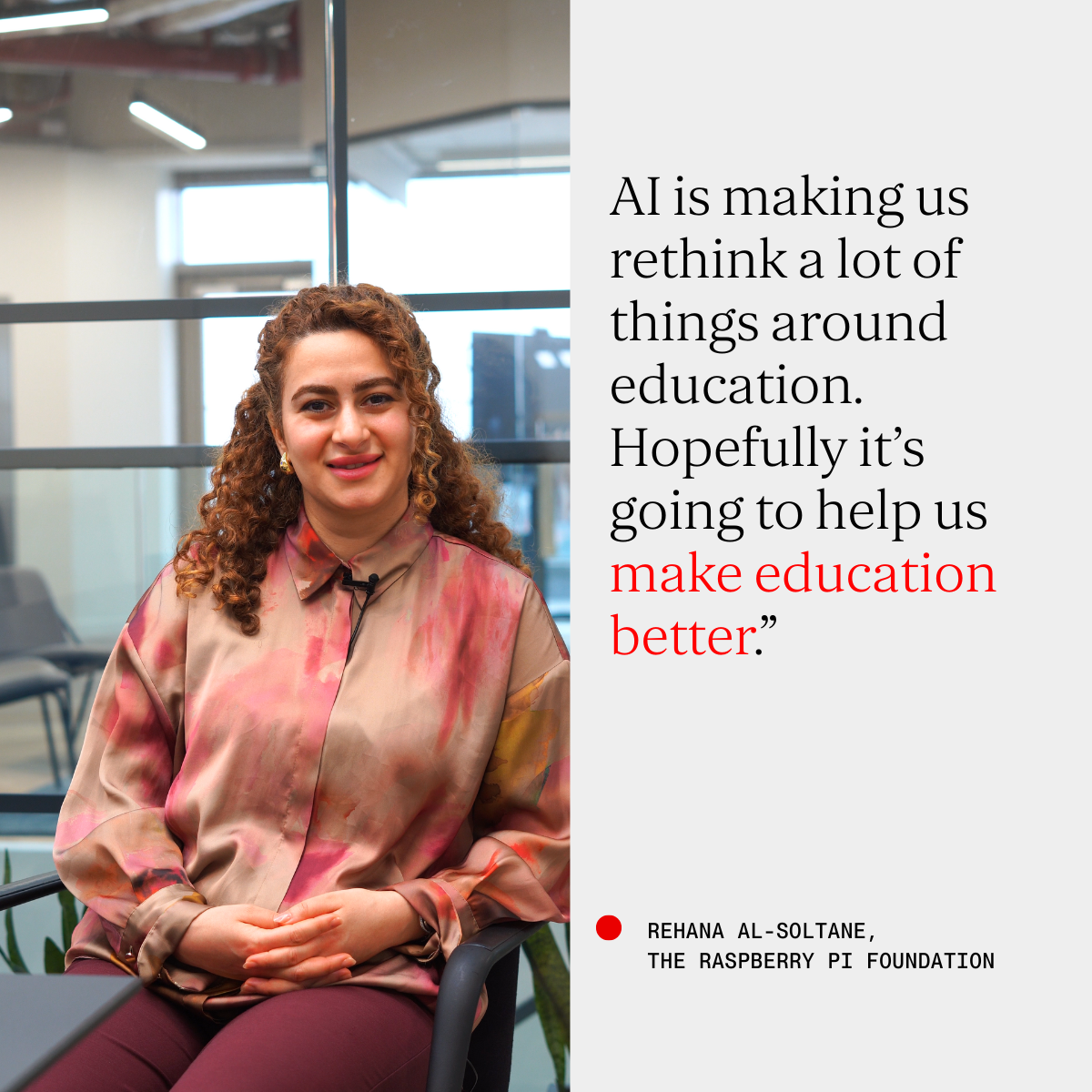
“It’s really important that people understand what AI is, because that means they understand it’s a data-driven tool.”
This distinction matters. When learners understand how AI systems make predictions (through calculations, patterns and data…often in split seconds) they are better equipped to question results, recognise limitations and use these tools responsibly.
In Rehana’s view, AI literacy isn’t about turning everyone into engineers. It’s about empowerment through understanding.
One of Rehana’s key concerns is how narrowly AI is often defined and taught.
“When we talk about artificial intelligence,” she explains, “most of our technologies are focused on text or language.” However language, she argues, is only one small part of what makes humans intelligent.
Today’s AI systems largely replicate this single dimension. Rehana believes their reach and impact could be far greater if we adopted a broader understanding of intelligence itself.
This isn’t a rejection of AI’s potential. In fact, Rehana is optimistic. She’s excited about how AI could help solve some of humanity’s biggest challenges. Particularly in education, from personalised learning to rethinking how we assess and support students. However, that optimism is grounded in realism.
“Technology is making us rethink a lot of things around education,” she says, “and hopefully it’s going to help us make education better.”
Rehana points out that many AI systems today are trained on datasets that fail to reflect the diversity of the world they’re used in.
Most image, video and text data comes from North America and Europe. This leaves vast parts of the world underrepresented.
“People’s rich cultures, their rich languages and the context that other people have around them are not represented in the data set.”
The result? AI tools that are less accurate and less relevant for most people around the world.
When AI systems lack cultural and linguistic representation, the consequences often appear quietly: incorrect predictions, limited relevance and exclusion by design. This is why Rehana believes learners need to understand how data shapes outcomes and why representation matters just as much as performance.
Another challenge Rehana highlights is the way AI tools are intentionally designed to feel human.
“AI tools are on purpose developed to be anthropomorphic,” - AKA designed to sound human, look human and encourage engagement.
While this improves usability, it comes with a risk. When AI feels human, people may develop an incorrect understanding of what the technology actually is. That means recognising AI not as intelligence with intent or agency but as a system making probabilistic predictions based on data.
The Raspberry Pi Foundation is a UK-based charity that empowers young people all over the world with free resources in computing, computer science and digital education. Under programmes like Experience AI, Rehana and her team are helping learners engage with AI critically, not passively.
At its core, Rehana’s work is about confidence. When learners understand AI, they are less intimidated by it. They can engage critically, creatively and ethically…rather than feeling overpowered or excluded.
AI literacy, as Rehana frames it, isn’t about preparing people for a future dominated by machines. It’s about ensuring that people stay in control of the future AI helps shape.
Passion Labs is an AI research and development lab building technologies and thought leadership that amplify human potential. Through our “In Conversation” series, we spotlight diverse voices shaping the future of AI, across industry, ethics, and creativity.