< Academy
In Conversation with Chinara Aliyeva
Blog
.png)
Salome Tirado
Marketing Lead
.png)
As organisations race to adopt artificial intelligence, much of the focus has been on speed. Building proofs-of-concept, testing new tools and exploring what’s possible.
But according to Chinara Aliyeva, AI Engineer at Boston Consulting Group, something critical is being overlooked. Responsibility isn’t something you add later, it has to be built in from the start.
Everybody’s talking about AI, and building multiple proof-of-concepts.”
On the surface, this looks like progress. But behind the scenes, many organisations are hitting the same wall: They can prove that AI works., they just can’t scale it. "The real challenge is going beyond that stage to MVP or production-grade systems.”
This gap isn’t just technical. It’s structural. Without the right data, systems and processes in place, AI remains stuck in experimentation, never fully delivering on its promise.
Part of the problem lies in how AI is understood.
“There is this misconception around AI, It’s not just prompt engineering.”
What sits behind even the simplest AI interaction is a much larger system:
Prompting may be the visible layer, but it’s only a small part of the picture. Real AI capability comes from designing the entire ecosystem around it.
At the same time, she explains that AI shouldn’t be viewed purely through the lens of efficiency.
“There is a huge space for repetitive work to be replaced by AI,” he says. “But it doesn’t mean the human element will be replaced.” By taking on repetitive, time-consuming tasks, AI creates space for more meaningful work, from creativity to strategic thinking. Yet many still see it as a threat.
“I think people usually see new technology as a threat to their work. But it’s actually the opposite. It opens up alternatives.”
As AI systems become more embedded in organisations, the stakes become higher.
This is where Chinara;s core message becomes clear:
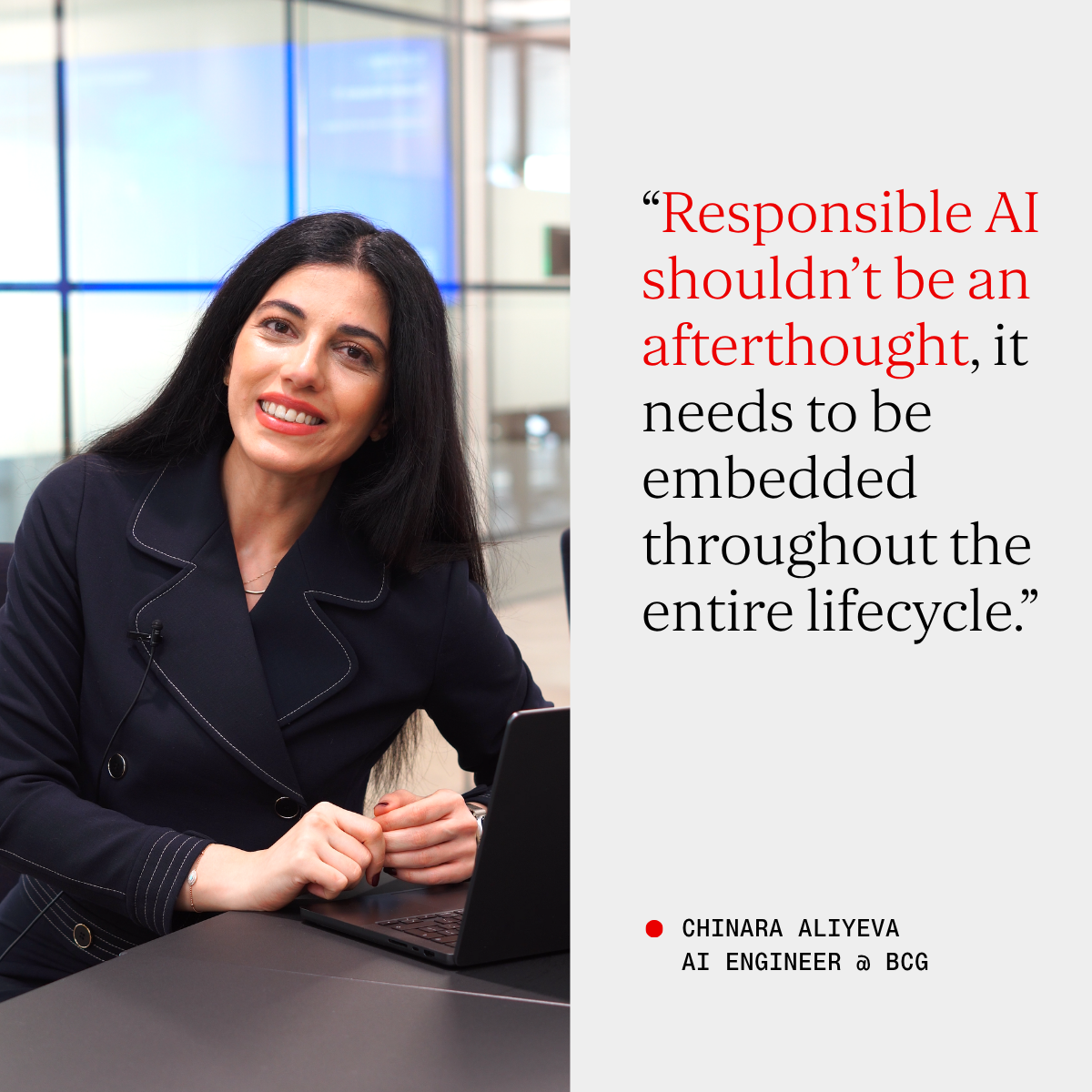
“Responsible AI shouldn’t be an afterthought, it needs to be embedded throughout the entire lifecycle.”
Responsibility isn’t a final checkpoint. It’s not something applied once a system is built.
It needs to be considered at every stage:
Without this, even the most advanced AI systems risk falling short, not just technically, but ethically.
Chinara's perspective highlights a shift that many organisations are still grappling with. AI success isn’t defined by how many proofs-of-concept you build. It’s defined by whether you can turn them into systems that are scalable, reliable and responsible. That requires more than experimentatio, It requires intention.
Passion Labs is an AI research and development lab building technologies and thought leadership that amplify human potential. Through our “In Conversation” series, we spotlight diverse voices shaping the future of AI, across industry, ethics, and creativity.