< Academy
MiroFish: Agent-Based Social Simulation Explained
Research

Dr Nadine Kroher
Chief Scientific Officer
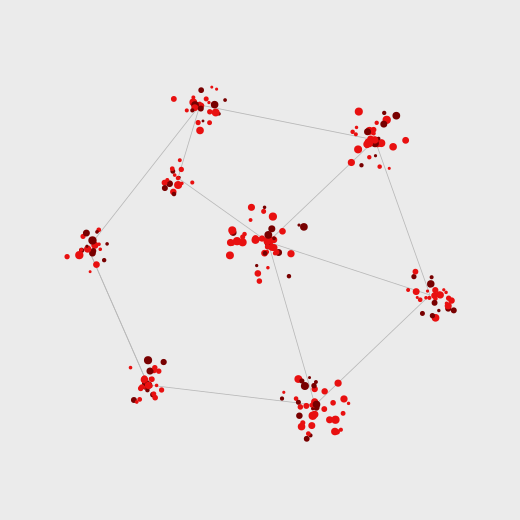
MiroFish is a GitHub repository that went viral in early 2026, hitting number one on GitHub's global trending list and accumulating over 33,000 stars. In this edition of Passion Academy, Nadine from Passion Labs breaks down what it actually is, how it works, and where to be cautious with it.
MiroFish calls itself a swarm intelligence engine. But more precisely, it is an agent-based social simulation. Rather than following simple collective rules, it simulates thousands of individual synthetic personas inside a custom-built virtual world, and observes what emerges from their interactions.
It has already been used for:
(We've also covered OASIS, another agent based social simulation engine. Check it out here).
At the core of every simulation is seed material, a detailed description of the world you want to simulate. This needs to include:
The system will not invent new entities on its own. Everything that matters needs to be defined upfront.
Once the seed is ready, MiroFish uses GraphRAG to construct a knowledge graph. This does more than store facts, it encodes relationships between entities. The system knows not just what a company is, but how it connects to people, products and other organisations.
Memory is managed using Zep, which handles both:
Each agent is given a full profile:
The social simulation itself runs on Oasis, an open-source social network simulator. Two environments are available — a short-form platform similar to X, and a threaded discussion platform similar to Reddit.
The simulation runs in cycles. In each cycle, every agent:
Each action updates their beliefs and memory. This repeats across many cycles, essentially fast-forwarding through a social network over simulated time.
Once the cycles are complete, a specialised report agent processes everything and looks at:
You can also interact directly with individual agents, inject new assumptions mid-simulation, or rerun with different parameters.
MiroFish is an impressive and genuinely fun tool. But two things are worth keeping in mind.
First, there is no published benchmark. Oasis, the underlying social simulator, has been used in controlled academic studies and has real scientific grounding. MiroFish as a general-purpose prediction engine has not been formally evaluated. It is an interesting exploration tool, not a proven forecasting system.
Second, token costs are significant. Running hundreds of agents across many cycles generates enormous context. Starting with lighter, cheaper model variants is strongly recommended before scaling up.
What makes MiroFish interesting is not just the tool itself but what it represents. Agent-based modelling has a long history in social science and economics. What MiroFish does is dramatically lower the barrier to running these simulations, by combining existing open-source tools (GraphRAG, Oasis and Zep) into something fast and accessible to set up.
The potential applications across policy, finance, product research and communications are real. It will be great to see how the benchmarking and scientific grounding catches up with the hype.
If you enjoyed this article, checkout our article on OASIS, another agent based social simulation engine. Check it out here.
https://github.com/666ghj/MiroFishhttps://mirofish.ink/