< Academy
Passion Labs launches in Australia
Blog

Tom Lorimer
Chief Executive Officer

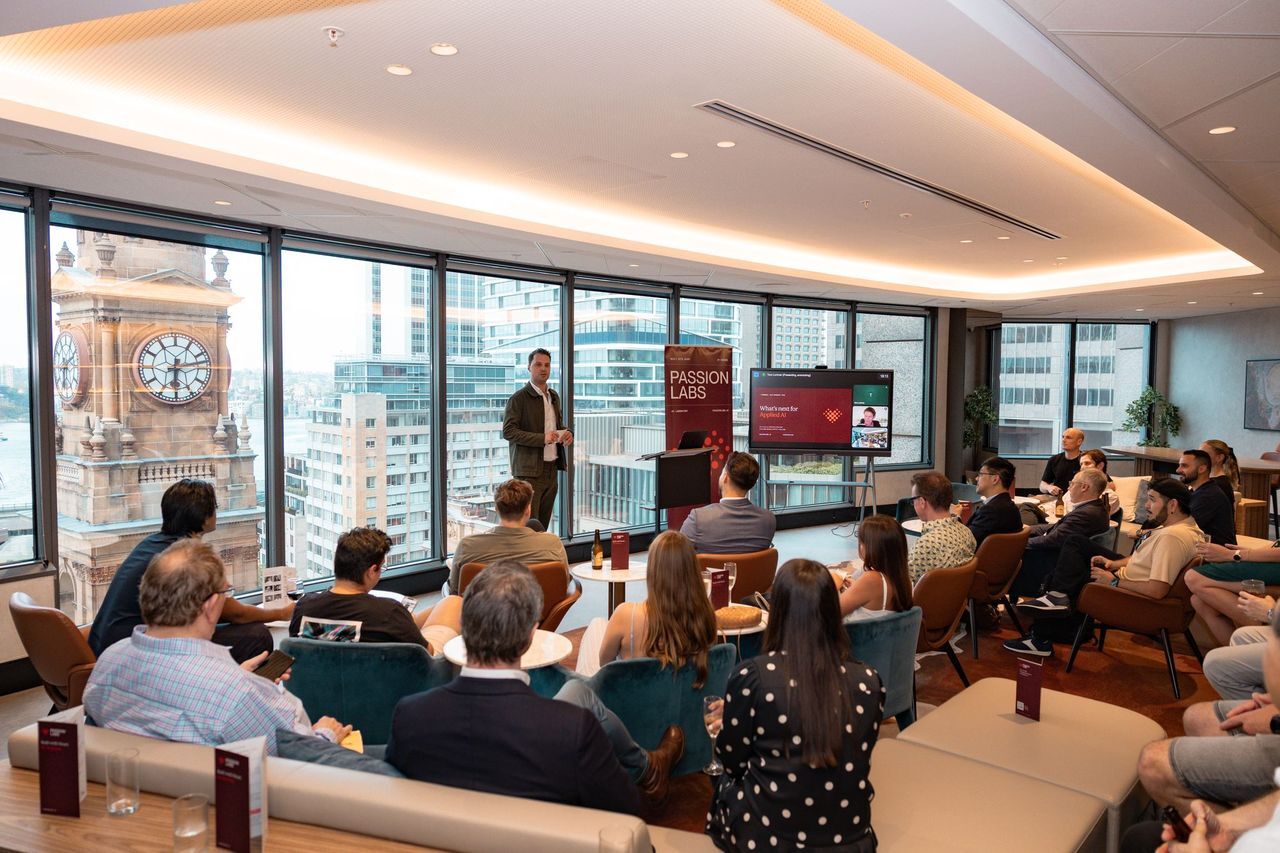
We brought Passion Labs to Sydney for the official launch of our Australian presence, welcoming business leaders, technology enthusiasts and curious minds for an evening of conversation about the future of artificial intelligence.
It was an opportunity to introduce the team, share what we've been building and, perhaps most importantly, explore where we see the biggest opportunities for AI in Australia.
Hosted by our CEO and Co-Founder, Tom Lorimer, the evening brought together perspectives from across the business, with our Chief Scientific Officer, Dr Nadine Kroher, joining to explore some of the technical developments shaping the field.
But this wasn't a talk about the latest AI tools or how to write better prompts. As an AI research and development lab, our focus is on something much deeper: solving complex problems through intelligent systems that go beyond what's possible with off the shelf technology.
Australia presents an exciting opportunity for applied AI.
It's a sophisticated service economy with some particularly interesting industries, including agriculture, mining, energy and logistics. These sectors generate enormous amounts of valuable data, often in formats that traditional AI tools struggle to interpret. We believe there is significant untapped potential here.
While generative AI has made its way into everyday business operations, there is still a considerable gap between experimenting with AI and embedding it meaningfully into an organisation. Many businesses have explored proofs of concept and built impressive demonstrations, but getting these systems into production, where they can deliver measurable value, remains a much bigger challenge. This is precisely where we see an opportunity for Passion Labs.
We want to help Australian businesses move beyond experimentation and build AI systems that address real operational challenges, whether that's optimising complex processes, making better use of existing data or developing entirely new capabilities.
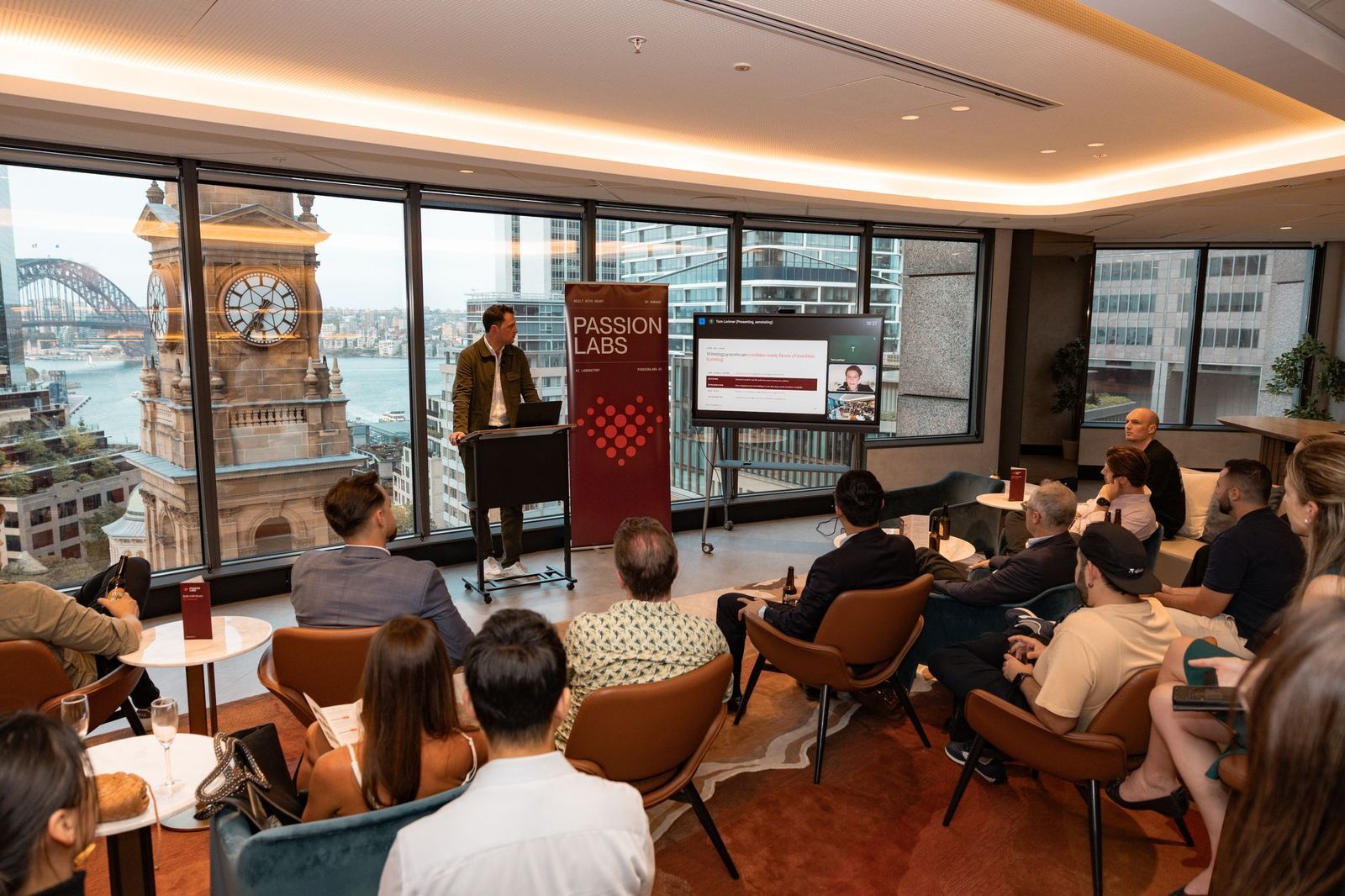
During the evening, Tom shared examples of work we've delivered across different industries, illustrating what becomes possible when you look beyond large language models alone.
In media and marketing, we've developed systems that bring together campaign data from multiple platforms, giving teams a clearer picture of performance and making it easier to explore insights through natural language. We've also been researching how synthetic personas can help creative teams test ideas and understand how different audiences might respond before committing time and budget to production.
In aviation, we've built a reinforcement learning system designed to optimise aircraft maintenance schedules, balancing preventative maintenance with the goal of keeping more aircraft in the air.
And in agriculture, we've developed a multi agent system that brings together information such as soil tests, animal health records and crop data. This allows farmers to ask questions and access useful insights without having to navigate multiple systems.
These projects are very different, but they share a common principle: the technology should be chosen around the problem, not the other way around. That's the difference between simply adopting AI tools and building intelligent systems that can genuinely change how a business operates.
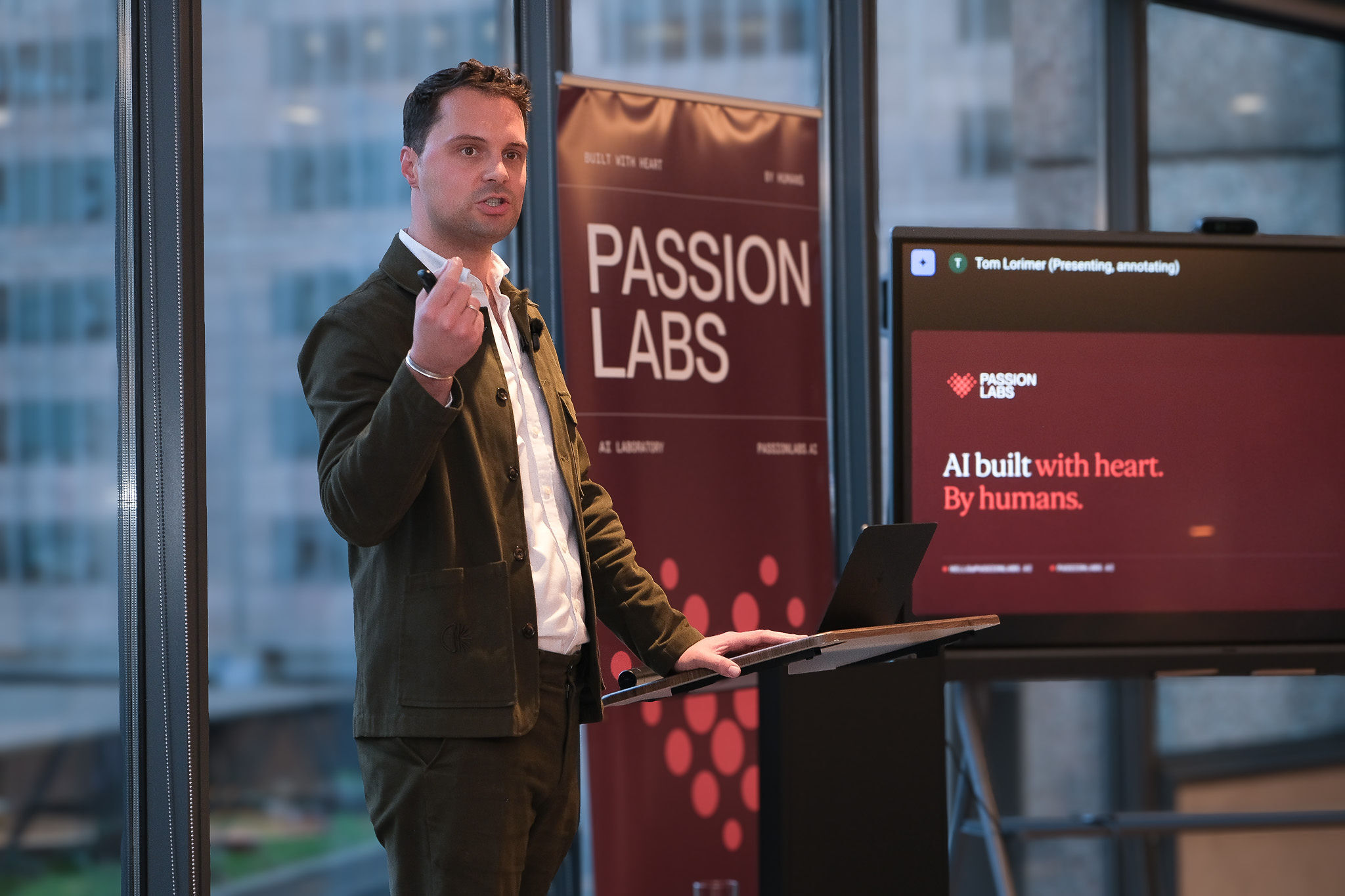
Dr Nadine Kroher then took the conversation into some of the underlying technical developments that we believe will have a significant impact on how businesses use AI. Rather than revisiting the latest model releases, Nadine focused on three areas that we're actively researching and developing at Passion Labs.
Large language models are particularly good at generating and interpreting language nut not every business problem requires a written response. Consider a system that needs to identify whether a transaction is fraudulent, score a candidate against a recruitment brief or determine which department should handle a customer enquiry. In these situations, the system needs to make a structured decision, not generate paragraphs of text.
Decision models are designed to do exactly that. They can be faster, more efficient and less expensive than using a general purpose language model for every task. They can also be fine tuned for specific business applications.
Businesses hold valuable information in all sorts of formats, from technical drawings and audio recordings to complex graphs and other specialised datasets.
The challenge is that large language models are primarily designed to work with language. Simply uploading a file or converting something into an image doesn't necessarily give a model the information it needs to understand it properly.
Data adapters offer another approach. They act as a bridge between different data types and AI models, learning how to translate complex information into representations that a model can work with.
This opens up interesting possibilities for industries where some of the most valuable information isn't stored in conventional documents or spreadsheets.
The third area was reinforcement learning, one of the most exciting areas of machine learning that we work with.
Unlike conventional models trained on labelled examples, reinforcement learning systems learn through interaction with a simulated environment. They take actions, receive feedback and improve their decisions over time.
This makes them particularly useful for problems involving optimisation and sequential decision making.
Applications include fleet management, route planning, production scheduling and preventative maintenance. These are problems where the best decision depends on a complex set of changing variables, rather than a straightforward prompt and response.
Nadine also touched on how we're exploring reinforcement learning to improve retrieval systems, helping AI models identify which information is genuinely relevant when answering questions from large and complex knowledge bases.
Another major theme throughout the evening was data. As AI systems become more sophisticated, the competitive advantage is increasingly shifting away from simply having access to the latest models. It is about the data, knowledge and context that sit around them. An organisation's existing information, processes and expertise can be incredibly valuable. The challenge is making that knowledge accessible and useful to AI systems in a reliable way.
We also heard a lot about data sovereignty during our conversations with Australian businesses in the lead up to the event. For many organisations, where their data is stored, which models process it and who has control over their infrastructure are fundamental considerations when adopting AI. These aren't questions that should be left until the end of a project. They need to be considered from the outset.
At Passion Labs, our approach is deliberately flexible. We can work with different models and deployment environments, including locally hosted infrastructure, allowing us to design systems around an organisation's technical, operational and governance requirements.
One of the bigger ideas discussed during the evening was the emergence of what we might call self improving organisations. Imagine a business where information from everyday operations, including communications, processes and decisions, feeds into a shared layer of organisational knowledge.
That knowledge can then inform different business functions, helping systems identify inefficiencies, support decisions and continuously improve how work gets done.
We're still some way from realising the full potential of this vision. There are significant technical challenges around reasoning, context and working reliably with unstructured information. However, the direction is becoming increasingly clear. AI is moving beyond individual productivity tools towards systems that can understand how an organisation operates and help improve it over time. It's something we're already exploring within Passion Labs itself, and an area we expect to see develop considerably over the coming years.
The launch in Sydney marks an exciting milestone for Passion Labs.
We started with a simple ambition: to advance the state of the art in artificial intelligence while making that research useful in the real world. That ambition remains at the centre of everything we do.
Expanding into Australia gives us the opportunity to bring our research and engineering capabilities to a new market, work alongside ambitious businesses and explore challenges across industries where we believe AI can make a meaningful difference.
A big thank you to everyone who joined us in Sydney, shared their perspectives and helped make the evening such a great start.
We're looking forward to the conversations, collaborations and projects ahead!