< Academy
Passion Labs plants flag in Sydney, targets ‘underserved’ AI opportunities
Blog

Tom Lorimer
Chief Executive Officer

Read the orignal article here, written by Julia Talevski
UK-based AI lab Passion Labs has officially launched in Australia, opening a Sydney office and appointing local leadership as it eyes opportunities in sectors it believes have been overlooked by the first wave of generative AI adoption.
Founded in September 2024, the company specialises in building custom AI and machine learning systems for enterprise customers, focusing on complex operational and industry-specific problems that founder and CEO Tom Lorrimer states cannot be solved using off-the-shelf large language models alone.
Speaking at the firm’s Sydney launch event, Lorimer said Australia represented a natural next step in Passion Labs’ international expansion after establishing traction in the UK and Europe.
“America is crowded, noisy and saturated,” he said. “Australia is significantly less saturated, much earlier on in this wider AI race, and it’s rich in industries that are rich in data but have been largely underserved by the frontier labs.”
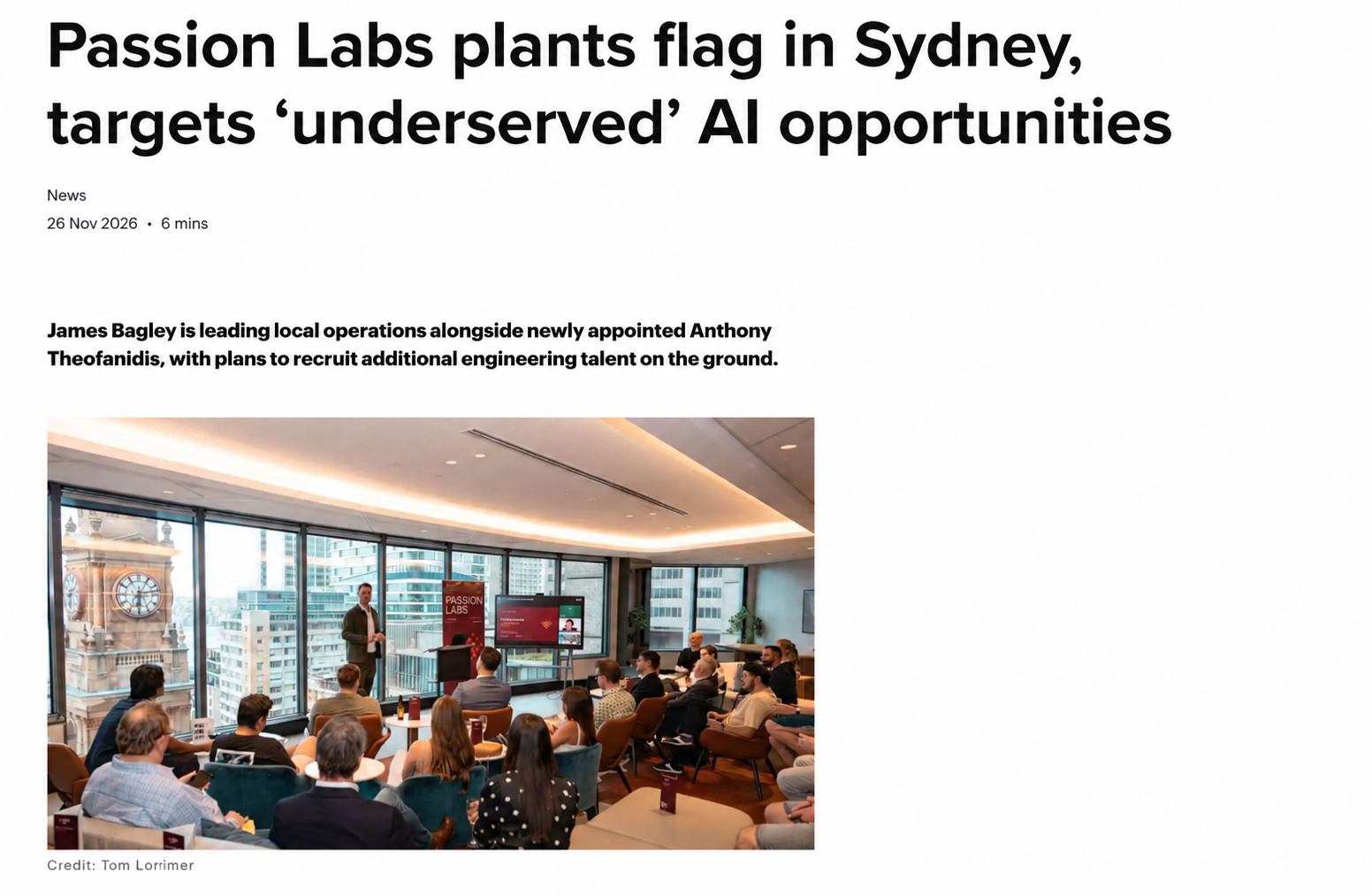
The Sydney expansion sees James Bagley leading operations locally, alongside newly appointed commercial hire Anthony Theofanidis, with plans to recruit additional engineering talent on the ground.
According to Lorimer, Passion Labs has grown to around 18 staff globally, including three PhD-level research scientists and seven machine learning engineers, while delivering more than 50 AI and machine learning deployments across industries including media, aviation, agriculture and financial services.
While much of the current AI market remains focused on generative AI tools such as OpenAI’s ChatGPT and Anthropic’s Claude, Lorrimer believes many organisations are overlooking broader machine learning opportunities.
“People think AI starts and finishes with ChatGPT,” he said. “There’s a whole blue ocean out there.”
The company’s projects span a range of specialist use cases. For the BBC, Passion Labs built a multi-agent system designed to support television production planning, enabling producers to assess programme concepts against simulated audience profiles before commissioning content.
In aviation, the company developed a reinforcement learning system for private aviation operator Thunder to optimise aircraft maintenance schedules and maximise flight availability.
Elsewhere, the company has built AI models trained on soil and agricultural datasets to create digital twins of farmland, allowing growers to simulate crop performance and improve decision-making.
Lorimer said many of Australia’s largest industries present similar opportunities.
“Mining, agriculture, utilities and energy are handling very interesting data types and lots of it,” he said. “A lot of it is still largely underserved.”
A central theme of the company’s Australian market strategy is the gap between experimentation and production-scale deployment.
According to data that Lorimer shared, while 88 per cent of Australian SMEs have used AI in some form, only a small proportion of enterprises have embedded the technology deeply within operations.
Lorimer said many organisations remain trapped in proof-of-concept mode, building demonstrations on top of large language models that never progress into business-critical systems.
“A lot of these exciting proof-of-concepts are fun to show in a boardroom,” he said. “Actually scaling that across an organisation is challenging.”
He believes industries such as mining, construction, transport and agriculture will become the next frontier for AI adoption because they rely heavily on operational data, sensor information and complex physical assets rather than traditional documents and text-based workflows.
Examples include predictive maintenance systems, route optimisation platforms, geospatial analysis tools and machine learning applications designed to interpret lidar, sonar and other non-traditional datasets.
Lorimer said data residency and model hosting requirements were consistently raised during early customer discussions, amplifying the growing importance of AI sovereignty among Australian organisations.
“Four organisations wouldn’t even continue the conversation until we could assure them their data was going to stay in Australia,” he said.
The issue is expected to become increasingly important as governments and enterprises grapple with questions around national capability, governance and dependence on overseas AI providers.
As a result, Passion Labs is positioning itself as a flexible deployment partner capable of hosting models and workloads locally where required. The company also predicts growing demand for smaller, purpose-built AI models rather than solely relying on large general-purpose systems.
“We’ll see the rise of smaller language models, domain-specific fine-tuned models and decision models,” Lorimer said.
An important aspect of Passion Labs’ Australian strategy is its intended engagement with the local partner ecosystem.
Theofanidis said many MSPs and IT services firms are struggling to develop sophisticated AI offerings despite growing customer demand.
“There is a gap,” he said. “Customers increasingly go to a BCG or an Accenture for AI capability, whereas the MSP could have been part of that conversation if they had the right partnership.”
The company sees an opportunity to work alongside service providers seeking to deliver advanced AI projects without building deep machine learning research teams internally.
Theofanidis said the approach would be selective, centred on partners serving larger customers with complex operational challenges rather than organisations pursuing simple chatbot deployments.
Looking ahead, Lorimer identified three themes he believes will define the next phase of enterprise AI adoption.
The first is stronger data foundations, with organisations investing in cleaner, more accessible data infrastructure to support AI deployments.
The second is sovereignty, driven by increasing concerns around governance, security and local control of AI systems.
The third is what he describes as “self-improving organisations”, where agentic AI systems continuously analyse operational data, workflows and business processes to optimise performance with minimal human intervention.
“We’ve had hierarchical organisational structures for centuries,” Lorimer said. “Increasingly, we’ll see flatter structures with agentic layers underneath.”
“We haven’t yet scratched the surface of what’s to come. There are lots of interesting problems to solve.”